Showing posts with label Florida. Show all posts

Saturday, February 24, 2018

Before the Iron Horse

 There were real horses. And in Florida that meant cowboys.


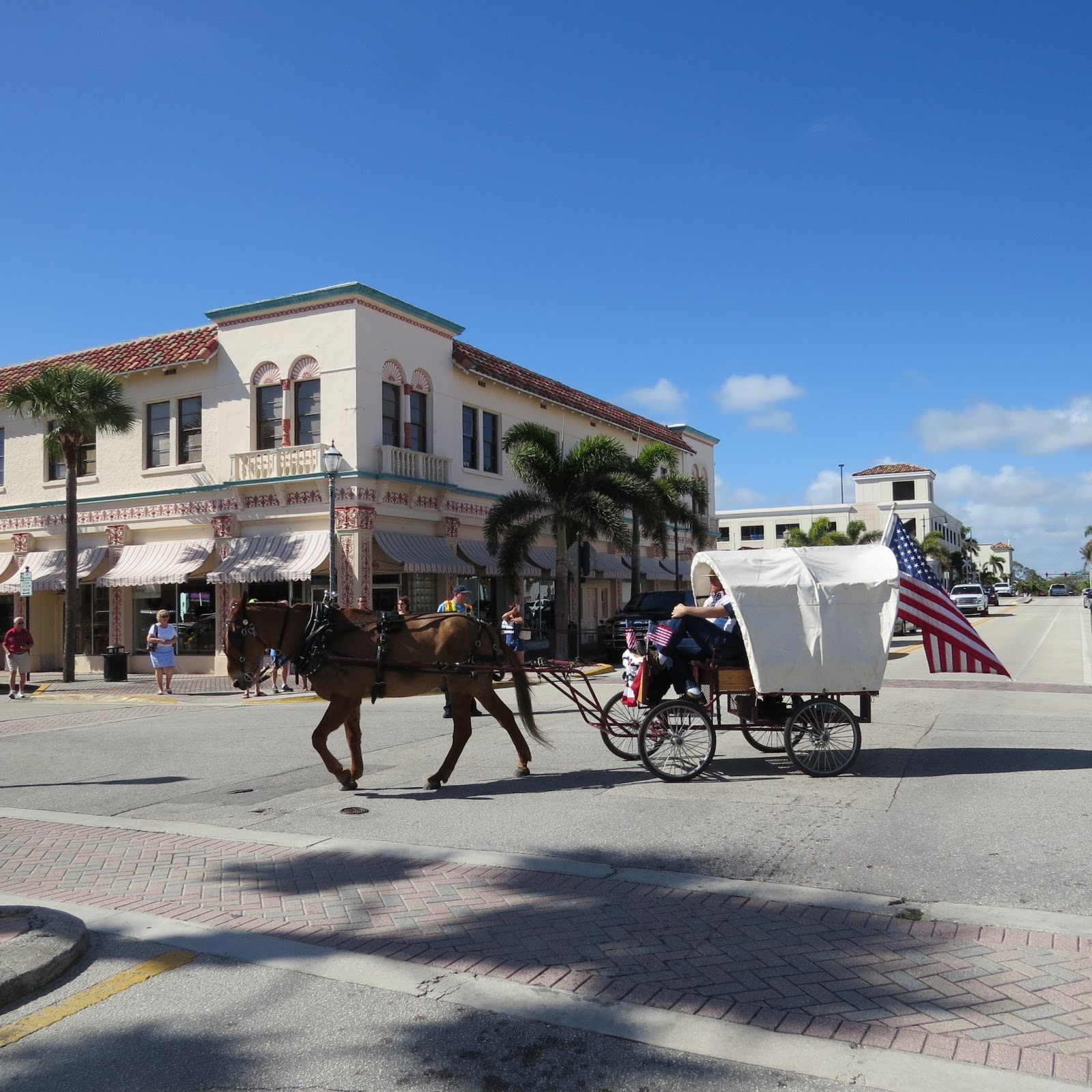
OK, Cowgirls. The 31 annual Florida Cracker Trail Ride across the state ended Saturday, February 24, 2018 with a parade in Fort Pierce. The ride started Feb. 17 on the west coast in Bradenton honoring the Florida cowboy pioneers.

After the War Between the States (recent unpleasantness) a group of pioneers were know as Florida Crackers because of the cracking sound from the whips they used to drive cattle and oxen pulling carts and wagons. Every year they would drive the scrub cattle across the state from west of Ft. Pierce to Bradenton and then to Punta Rassa for shipment to Havana, Cuba. Other sources say the cattle operations started earlier.


The Cracker Trail was the only dry route across Florida with the Kissimmee River and its floodplains to the north and Lake Okeechobee and the Everglades to the south. For more information, go to crackertrail.org.

For another interesting read see:  Jacob Summerlin (February 20, 1820 – November 4, 1893), aka the King of the Crackers and King of the Cracker Cow Hunters, was reputed to be the first child born in Florida after the land was ceded by Spain.


Thursday, March 9, 2017

Staurt Florida FEC Bridge

This is the FEC bridge over the St Lucie River just north of downtown Stuart. It is taken from the north shore between the tressel and the old Roosevelt drawbridge. The new fixed Roosevelt bridge is in the background.
I have been wanting to get a video of a train crossing the bridge but always miss. I found one on YouTube taken by someone else. Upstream is to the right and divides into the North and South Forks of the St. Lucie just past the old bridge.

Friday, January 6, 2017

FEC with GE Evolution LNG Locomotive

Seen Southbound in Jupiter, Fl. operating as FEC Train #109 mixed freight January 4, 2017. Paced at 50 MPH so it went by quickly.
FEC 807 (ES44C4) , LNG Fuel Tender, GE Evolution NextFuel locomotive #3000.

From Wikipedia: In 2013, General Electric built one ES44AC, GECX 3000, as a test bed for their NextFuel natural gas power kit. The engine runs on liquefied natural gas from a fuel tender. The unit is currently part of BNSF's GE LNG test set, partnered with BNSF ES44AC no. 5815.


Some stills. Sorry for the quality, moving pretty fast and hard to find a decent spot to take pictures. 


FEC 807 was lead locomotive


Followed by the Liquified Natural Gas tender


Then the GE NextFuel locomotive.


Friday, December 2, 2016

FEC 428 Stuart, Fl.

FEC 428 in Stuart at A1A crossing 12-01-2016. (Approx. MM 262) EMD GP-40-2
FEC ordered 24, road numbers 411–434. 


Note the section crew just past the crossing. I was listening on the scanner and after the train passed I heard them call the dispatcher and tell him they were going back to work repairing the broken rail. It is single track here, just north of the Port Sewall passing track.

Bonus: If anyone is interested "A Railfan's Guide to the FEC, Version 32A, prepared 7/25/98" is available here.

Sunday, November 13, 2016

Okeechobee Waterway Railroad Bridges

The Okeechobee Waterway crosses Florida from Stuart on the east coast to Ft.  Myers on the west coast crossing Lake Okeechobee. Shown east to west from Stuart to Lake Okeechobee.


Bonus Tugboat
Gives a feel for size

Britt Point Bascule Bridge at Stuart
FEC


Indiantown Swing Bridge
CSX


Port Mayaca Lift Bridge
South Central Florida Express
(Was FEC K-line)

Slightly off topic but we went by the Port Mayaca Cemetery, site of the mass burial after the 1928 hurricane that collapsed the earthen dike around Lake Okeechobee. 


Saturday, May 14, 2016

Jupiter Florida Train Wreck - 1934


Since we are posting about Jupiter, Florida here is a story about a train wreck at the FEC railroad bridge over the Loxahatchee River. This bridge is just west of the highway A1A bridge (which is just west of the US 1 bridge). See the link for more of the story.

"I think the train was called the FloridaSpecial, which came out of New York. It was the second section of the train...

The three sections were heading south. The first passed safely across the closed bridge and then the bridge raised. There is a single span on the north side of the bridge that points up in the air when the bridge isn't closed. We could see the sparks as from the wheels on the rails from as far away as where Tequesta Drive is today as the engineer locked his brakes. The whole thing happened like it was in slow motion. The train couldn't have been doing more than 3 or 4 miles an hour as it hit the upturned bridge span and nosed down into the water. It was fortunate that the crash happened on the side where the span was in place because it helped to stop the train."

At the inquiry, the fireman stated that "We had slowed down real good and if we had about another 150 or 200 feet we could have stopped but as it was we just kinda slud into the water."
"Was anyone hurt?" I asked.
"No, the train was going so slow at the time. The engineer replied that he been going through yellowlights all the way down the line from being close to the train sections ahead of him and had assumed that this caution light was because of the train ahead of him. By the time the red light came on to indicate the bridge was up, the brakes were already locked." One other interesting sidelight of the day's events was mentioned by Mr. White with a smile. "One of the reasons there are few pictures is that the train was loaded with wealthy men who were coming to Florida with their girlfriends. They didn't want their pictures taken. They also didn't want to wait around. They were offering to pay $100 for a ride to The Breakers in Palm Beach. I got my car and made four trips myself that day, so I made $400.
Florida East Coast Railway Historian Seth Bramson isn't so sure about the $100 per ride part of the story.

Tuesday, May 10, 2016

St. Lucie FEC Bridge Work

Headed to Jupiter today for lunch and to enjoy the view. When we crossed the St. Lucie River in Stuart I noticed activity on the FEC bridge. Had to stop and get a couple of pics. Not sure what they were doing exactly but they had a large crane on a barge and several workers on the bridge. Couldn't miss an opportunity for pics of railroads and boats. I still want to get a video of a train crossing there.


We went on to Jupiter Inlet about 25 miles south, grabbed an Italian sub for lunch and found a picnic table in the shade. Now for an off topic picture.

The sportfishing boat was headed out the inlet and that is the Jupiter Lighthouse behind it. The Indian River  is just to the right of the lighthouse and the Jupiter and Lake Worth narrow gauge railroad northern terminus was on the same side of the river we were just to our left. That is the  Loxahatchee River right in front.  

Saturday, January 16, 2016

Bahia Honda Railroad Tressel

A previous post about the Overseas Highway reminded me of the uniqueness of the Bahia Honda bridge.

From Wikipedia:
It was purchased by the state of Florida and converted for highway use in 1938.[4] Rather than rebuilding the bridge, the top of the structure was redecked for use as the Overseas Highway (the existing deck inside the truss was too narrow for vehicular traffic).....

Before being reused as a highway bridge, the Bahia Honda Rail Bridge carried a single track of FEC across Big Spanish Channel from Bahia Honda Key to Spanish Harbor Key. Unlike other bridges on the Overseas Railway, the Bahia Honda has a steel truss construction]This was a necessary difference from the predominate concrete arch form of the other bridges of the Overseas Railroad, as the channel is the deepest of those spanned, at 24 feet.


See the Wikipedia article for more information. The picture and video below make it easy to see where the original rails were and the highway deck.


Monday, December 14, 2015

Railroad that goes to Sea

There is just so much information on the Over-Sea Railroad it was difficult to decide what to post. Dan in Middle Georgia got me started when he sent me this article at Trainweb.org about Pigeon Key.  Great writeup by Mr. John c. Dahl with some neat photos. I have fished near Pigeon Key many times both from the 7 mile bridge and from a boat. The bridge had fishing catwalks but you had to walk a long distance out to them on the bridge. Really fun when a semi truck went by - not much room to get out of the way and hold on to the railing. Which was made from the original railroad track. Also note the bridge runs east-west, not north south as some might think.

Video about Pigeon Key


Lots of great photos of the history and building of the railroad in the next video.
Note the photo of FEC crane 3377 in 1935. It is in Ft. Pierce, Fl. now.


Monday, December 7, 2015

Railcar No. 91

Henry Flagler's private railcar, No. 91, was built in 1886 and carried Henry Flagler south to Key West following the completion of his Over-Sea Railroad in 1912. Today thousands of visitors tour the historic railcar at the Flagler Museum in Palm Beach, Florida.


Another longer video that includes Whitehall, Flagler's mansion.


H/T and many thanks to Dan for the link to the first video. 

Saturday, November 21, 2015

Callahan, Florida Sept. 21, 2015

Stopped by the West Nassau Historical Society and Museum in Callahan on the way home from Folkston. The museum was closed but I took some photos anyway.


The Callahan Subdivision is a CSX Transportation railroad subdivision within the Jacksonville Division on the former Seaboard Air Line Railroad. The sub extends northward 20 miles from Baldwin, Florida, where the Jacksonville Terminal Subdivision's S Line and Tallahassee Subdivision meet just north of Baldwin Yard, a classification yard. According to Jacksonville Division Timetable Number 4 published in 2005,[1] the sub runs from milepost SM-0.18 to milepost SM-20.0, where it joins the Nahunta Subdivision, a former Atlantic Coast Line Railroad, in Callahan, Florida.

See https://en.wikipedia.org/wiki/Callahan_Subdivision

This was my first try at turning still photos into a video. Used Open Shot in Linux Ubuntu.

Wednesday, August 12, 2015

Richmond Naval Air Station

Off topic but the Gold Coast Railroad Museum is located at the old base. Zoo Miami is also located here, University of Miami has used parts as a research facility ("South Campus") since 1948 and the CIA had a facility from 1961 until 1968. The base has a rich history but unfortunately all three hangars were destroyed by a fire that broke out during a hurricane on September 15, 1945. All the blimps, 366 planes and 50 cars were also destroyed.


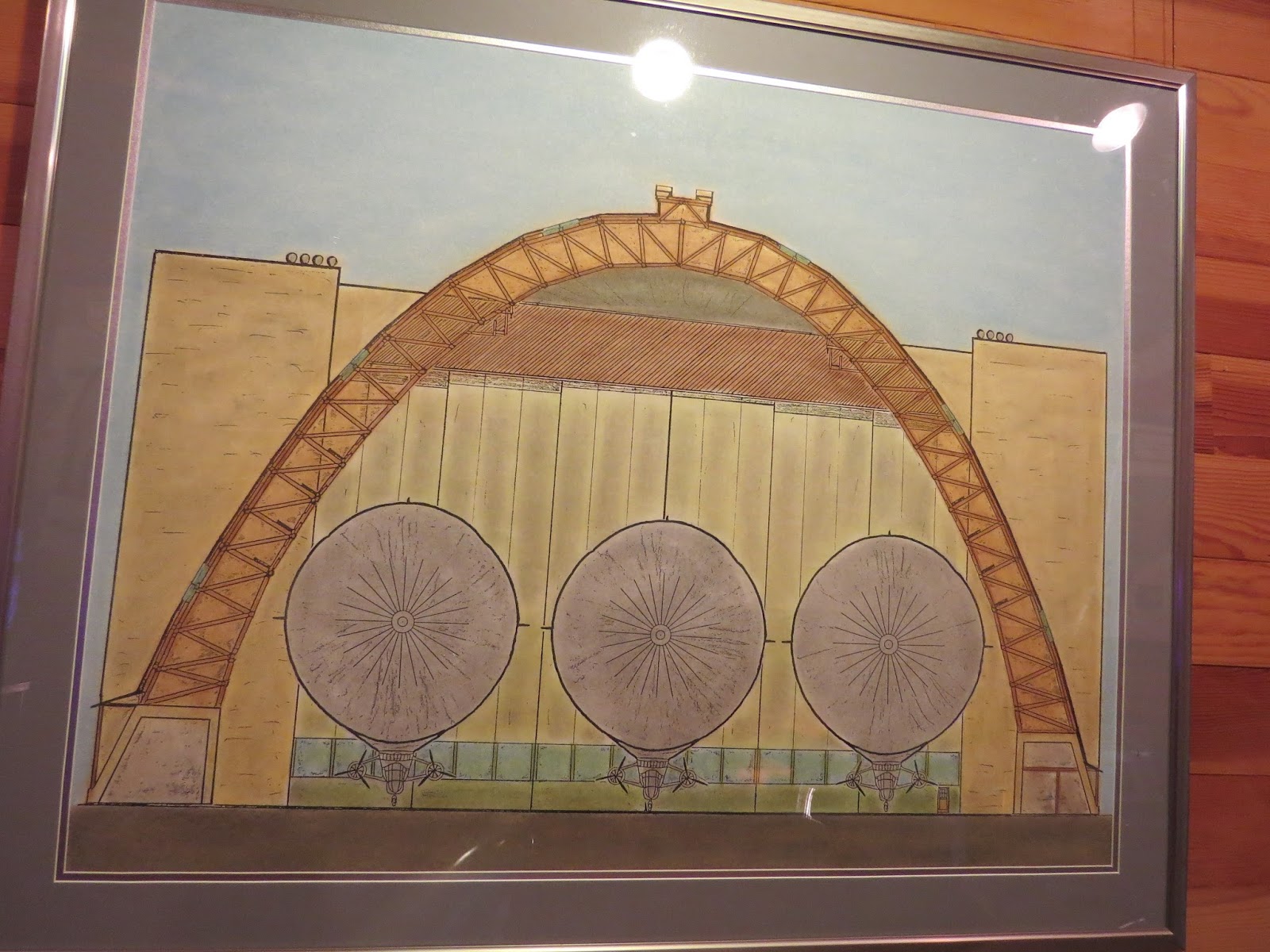
The Huge Airship Hangars

From a sign below the picture. 
What would fit in each hangar: Easily, 4 Boeing 747's, or over 1,200  parked automobiles could be placed on the open floor space of any one of these amazingly huge hangars. The total interior floor space of each hangar covered almost seven acres (297,000 sq. ft.). Four massive concrete door supports located at the corners of Hangar #1 were 148 ft. high and had a base of 28 ft. wide x 50 ft. long. They were one-of-a-kind, huge thick columns with a door pocket 12 ft. wide x 37 ft. deep. Only one of NAS Richmond's great door support columns remains - the east corner of "A & R" Hangar #1. It now "towers" over the Train Display Building and Museum Store of the gold Coast Railroad Museum. On the northwest face of the massive east door receptacle (the tower now remaining) you can see a long black arc. The arc traces the point at which Hangar #1s outer roof covering met the concrete face of the tower. Project this arc up beyond the concrete and you may imagine how the roof extended twenty-two feet above the 148-foot height of the concrete door pocket. At their highest point, the hangars were the height of a seventeen-story building, the fifty-one parabolic; wooden trusses in each of the three hangars contained approximately 2 million board feet of Oregon Douglas Fir. The use of wood saved over 16,000 tons (32,000,000 pounds) of war needed steel on this base alone! Roof construction of each hangar was facilitated by the use of a "Traveler", a huge mobile, wooden scaffold 150 feet high that spanned the inside width of the hangar. It moved along the hangar's roof and could have built approximately 250 three-bedroom homes. The openings at each end of the hangar #1 were 121 ft. high, and 197 ft. wide. To secure these huge portals, a set of six separate steel sections together formed the doors for each opening. Each of the six sections were 122 ft. high, 35 ft. wide and 4 ft. thick. Door sections weighed 39 tons each. Under the base of the doors the concrete was poured five feet thick. Hangar #1 was the first of these mammoth hangars to be completed. The first airship, "K-46", occupied hangar #1 on June 9, 1943. Hangars #2 and #3 were completed and in use shortly thereafter. 


East door receptacle on the remaining tower. Museum store also shown.


Above two photos show the concrete bases for the hangar wood structure.
The trains are in the structure on the left.


Gold Coast Railroad Museum web pages about the base. Includes some first person accounts and photos from both before and after the hurricane.

http://www.gcrm.org/index.php/exhibits/naval-air-station-richmond

An outstanding paper on the history of the base written by David Macfie, 23,
is a Senior at Florida International University, Miami, Florida, majoring in English. He is a native Miamian.
http://digitalcollections.fiu.edu/tequesta/files/1977/77_1_03.pdf


Sunday, August 9, 2015

Ferdinand Magellan / U. S. Car No. 1

Presidential Rail Car, U.S. Number 1

A National Historic Landmark

A Pullman  observation originally built in 1929 as a private car and converted for presidential use during WW II. It served as Presidential Rail Car No. 1 from 1943 until 1958.

The Gold Coast Railroad Museun acquired the Ferdinand Magellan in 1958 and it  arrived at the museum on January 15, 1959. In 1984 the Ferdinand Magellan was briefly loaned to the presidential re-election campaign of Ronald Reagan, who gave a series of "whistlestop" speeches from the rear platform during a one-day trip in Ohio.


Above photos July 7, 2015 at Gold Coast Railroad Museum, Miami Fl.


More photos and information at:

 http://www.gcrm.org/index.php/exhibits/ferdinand-magellan-us-car-1

https://en.wikipedia.org/wiki/Ferdinand_Magellan_%28railcar%29

Update: Thanks to Chickenmon I  found this while looking around YouTube.


Tuesday, July 28, 2015

Mural

A mural on the side of the barber shop in Jensen Beach, Florida. It was painted about 7 years ago by students at a local Martin County High School. Reportedly took about three days but I am not sure how much of that time was spent painting and how much was spent being teenagers. :-)
Note it is a 1 cent stamp.


The shop is only one building away from the FEC crossing on Jensen Beach Blvd.


H/T Chickenmom for the stamp image


Monday, July 6, 2015

Jupiter and Lake Worth Railroad


The Jupiter and Lake Worth Railroad was a 7.5 mile narrow gauge (3') connection between the south end of the Indian River at Jupiter Inlet and Lake Worth. It carried passangers form the steamboats traveling south from Melbourne and Titusville to connect with boats on Lake Worth. It was completed in 1889 and the end came in 1895 when it was bypassed by Henry Flagler's Florida East Coast Railroad.

More information and photos at:  http://www.taplines.net/jalw/jalwry.htm

 A very long, scholarly report "Retracing the Celestial Railroad" by Geoffrey Lynfield is found here:
http://ufdc.ufl.edu/UF00101446/00044/5j

Jupiter is about 30 miles south.


Here is a photo of The St. Lucie steamboat on the Indian River at Eden, just east of my location.

From the Library of Congress