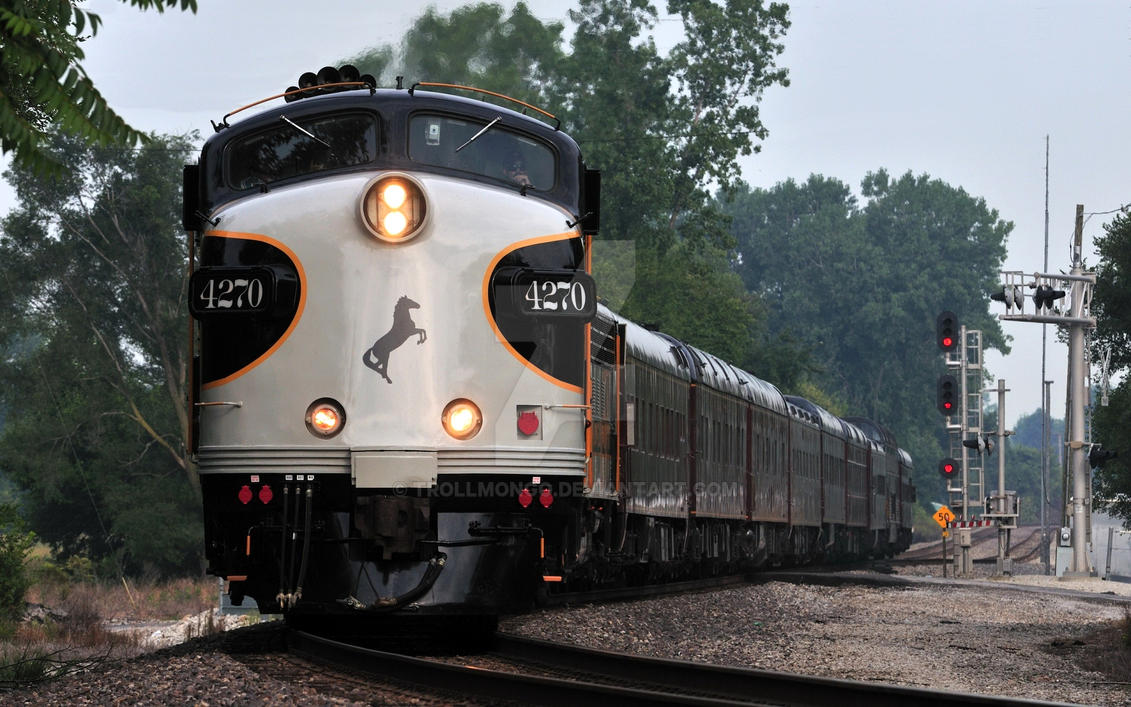
Something a little different, no train photographs. For the hardcore, there are some pics in the links. :)
The first ever railroad telegraph message was send and received in Orange County, NY in January, 1851
.
Samuel Morse invented his telegraphic code in 1832. Originally magnets were used to mark the dits and dahs on paper tape with ink. The telegraphers discovered they could decode the letters by the sound made by the machine, later to be called the sounder.
Sounder with resonator. Note the tobacco tin to give it a distinctive sound.
The first ever railroad telegraph message was send and received in Orange County, NY in January, 1851
. There is an interesting website with a nice telegraph page
here.
In addition to the sounder the telegraph key was essential. There are numerous styles but basically there are two kinds. The manual "straight key" and the semi automatic key or bug. Descriptions follow.
This is called a straight key. It is a Speed-X model J-38. J-38 is the
military designation from WW II. Note the shorting lever, required for
land line keys. No one mentions that the shorting lever was also
required for some older ham radios that used cathode keying. It was
closed when you wanted to use voice.
Next is the
Vibroplex "bug". It is a semi automatic telegraph key which automatically sends "dits" but the "dahs"
must be made individually. Vibroplex was founded in 1905 by Horace Martin and the basic design has remained unchanged.
I am also an amateur radio operator (ham). My straight key is pictured above. Here is my Vibroplex Original Standard. It is not very old, the serial no. is 108708.
Close up of the nameplate and "dit" contacts.
There are several versions of Morse code but the two that are important for this post. American and international Morse
American Morse Code — also known as Railroad Morse—is the latter-day name for the original version of the
Morse Code developed in the mid-1840s, by
Samuel Morse and
Alfred Vail for their electric
telegraph. The "American" qualifier was added because, after most of the rest of the world adopted "
International Morse Code,"
the companies that continued to use the original Morse Code were mainly
located in the United States. American Morse is now nearly extinct—it
is most frequently seen in American railroad museums — and "Morse Code" today virtually always means the International Morse which supplanted American Morse.
Another excellent article with some great photos found
here.
Ever wonder what all the wires on the poles that used to be next to the tracks were for?
- Carried telegraph communication, both railroad and public
- Dispatcher's voice communication
- Teletype communication
- Electrical power to run signals, switch machines, wayside detectors
- Wayside detector communication
- Vital signal information
Some of the lines were leased to companies like Western Union.
It has all been replaced by radio, satellite and buried cable / fiber.
EDIT: An
article by Jim Thompson, a retired Frisco telegrapher. Long but really interesting. Some history plus personal experiences.(Moved here from my comment below)