Tuesday, August 9, 2016

Radio Telegraph

After I did the Railroad Telegraphy post I thought I would mention another type of key and keyers. The electronic fully automatic keyer that uses "paddles". Instead of just two wires with bugs and straight keys, paddles have three wires, one for dit, another for dah and ground. They go the keyer. Close the contact between the dit wire and ground and they keyer generates dits for as long as the connection is made. Dahs are generated the same way, continuity between the dah wire and ground. To my knowledge, these keyers were never used with the railroad.

What happens if you close both contacts at the same time? Glad you asked. From Wikipedia:
"Iambic keying or squeeze keying creates alternating dits and dahs. This makes sending some characters easier, like the letter C, by merely squeezing the two paddles together. In single-paddle, non-iambic keying, the hand motion would require alternating four times for C (dah-dit-dah-dit).
Iambic keyers function in one of at least two major modes: Mode A and Mode B."

See the wiki article for the differences in modes. 

My newer ham radios have keyers built in.

Photos of my iambic paddles:

MFJ-564 similar to Bencher BY-1/2


Brown Bros Model BTL-A

dit dit

Saturday, August 6, 2016

Some Railroad Memorbilla


My very small collection of railroad collectables.

And a big Thank You to Ken Lane for adding to it.


Ashtray
Clinchfield Railroad Company
Enlarge to see the name. 


Playing cards from the Southern Pacific Lines.
I want to thank Ken Lane (Wirecutter) for giving these to me. And to Miss Lisa for coordinating everything. They belonged to one of his grandparents and have never been shuffled.

 The face of each card has a different picture.


Paperweight made from railroad track.
Approx 7" high, 6" across the foot and 1/2 " thick.
Weight 2 pounds
Track is graded by its linear density. This is at the highest
range of the usual pounds per yard at 141 lb/yd.


Track installation hardware. 
Spike, square head sleeper spike, e clip, railway anchor (top to bottom, left to right)


I don't have an original railroad lantern. This is close. It is a W. T. Kirkman #100 Watchman that is new. Red and green glass globes are available.


Sheet music from 1940.
See previous post here.

Thursday, August 4, 2016

Railroad Telegraphy

Something a little different, no train photographs. For the hardcore, there are some pics in the links. :)

The first ever railroad telegraph message was send and received in Orange County, NY in January, 1851.

Samuel Morse invented his telegraphic code in 1832. Originally magnets were used to mark the dits and dahs on paper tape with ink. The telegraphers discovered they could decode the letters by the sound made by the machine, later to be called the sounder.

Sounder with resonator. Note the tobacco tin to give it a distinctive sound.

The first ever railroad telegraph message was send and received in Orange County, NY in January, 1851. There is an interesting website with a nice telegraph page here.

In addition to the sounder the telegraph key was essential. There are numerous styles but basically there are two kinds. The manual "straight key" and the semi automatic key or bug. Descriptions follow.

This is called a straight key. It is a Speed-X model J-38. J-38 is the military designation from WW II.  Note the shorting lever, required for land line keys. No one mentions that the shorting lever was also required for some older ham radios that used cathode keying. It was closed when you wanted to use voice.


Next is the Vibroplex "bug". It is a semi automatic telegraph key which automatically sends "dits" but the "dahs" must be made individually. Vibroplex was founded in 1905 by Horace Martin and the basic design has remained unchanged.

I am also an amateur radio operator (ham). My straight key is pictured above.  Here is my Vibroplex Original Standard. It is not very old, the serial no. is 108708.


Close up of the nameplate and "dit" contacts. 


There are several versions of Morse code but the two that are important for this post. American and international Morse

American Morse Code — also known as Railroad Morse—is the latter-day name for the original version of the Morse Code developed in the mid-1840s, by Samuel Morse and Alfred Vail for their electric telegraph. The "American" qualifier was added because, after most of the rest of the world adopted "International Morse Code," the companies that continued to use the original Morse Code were mainly located in the United States. American Morse is now nearly extinct—it is most frequently seen in American railroad museums — and "Morse Code" today virtually always means the International Morse which supplanted American Morse.

 Another excellent article with some great photos found here.

Ever wonder what all the wires on the poles that used to be next to the tracks were for?
- Carried telegraph communication, both railroad and public
- Dispatcher's voice communication
- Teletype communication
- Electrical power to run signals, switch machines, wayside detectors
- Wayside detector communication
- Vital signal information
Some of the lines were leased to companies like Western Union.
It has all been replaced by radio, satellite and buried cable / fiber.

EDIT: An article by Jim Thompson, a retired Frisco telegrapher. Long but really interesting. Some history plus personal experiences.(Moved here from my comment below)


Sunday, July 31, 2016

The Conductors Birthday

It is the "Conductors" 17th birthday today, July 31

Happy Birthday Barron!


Dancing for his lunchtime treat today.

And to his littermate sister, Shadow.
They look so much alike.


Thursday, July 14, 2016

Stop. Look and Listen

Wig Wags and more! Wigwag is the nickname given to a type of railroad grade crossing signal once common in North America, named for the pendulum-like motion it used to signal the approach of a train


Illinois Railway Museum

Some pictures from our visit to the North Carlolina Transportation Museum in September 2015.


Click to enlarge / read


H/T to Chickenmom for the idea.

Monday, July 11, 2016

Communications and Signals:Then and Now


Lots of interesting information and some great video from Norfolk Southern Corp.


Love the NS logo.
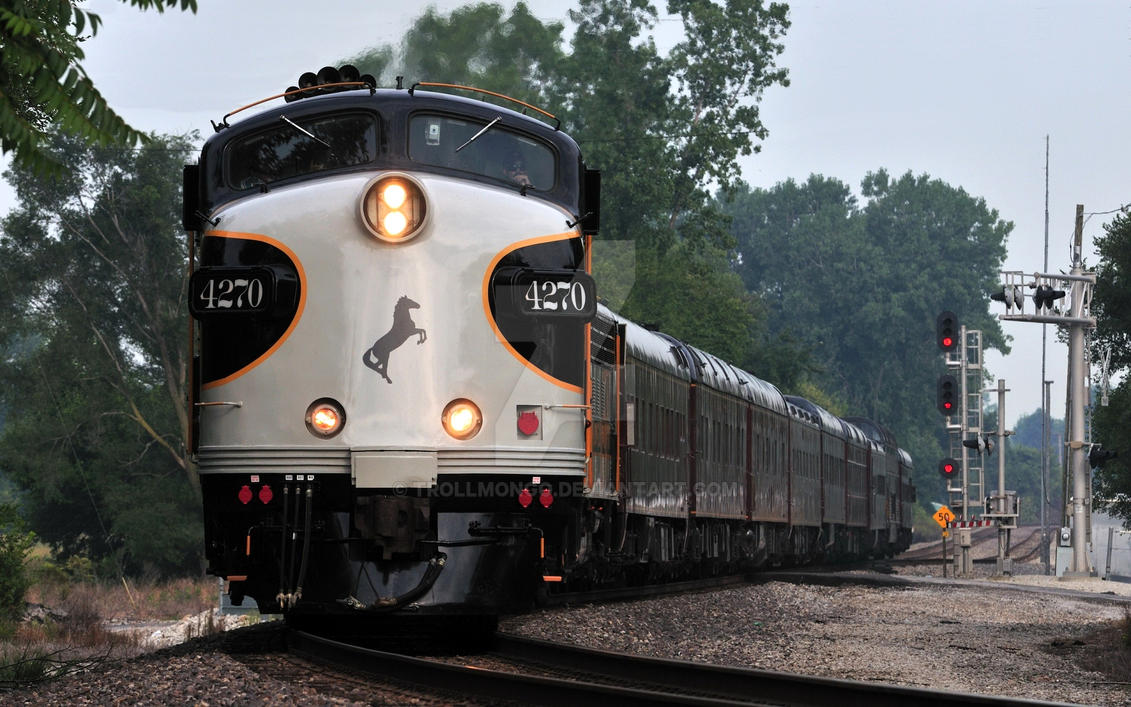
EMD F-9A

Two units still active.  More here.


Sunday, July 10, 2016

Vintage Video

I think Chickenmom may have posted this some time ago, but I had to post it anyway.

Footage shot between 1897 and 1906 by the Edison & Biograph Production Company

From "America's Railroads: A Steam Train Legacy" by Timeless Media Group

h/t dmt