Off topic but the Gold Coast Railroad Museum is located at the old base. Zoo Miami is also located here, University of Miami has used parts as a research facility ("South Campus") since 1948 and the CIA had a facility from 1961 until 1968. The base has a rich history but unfortunately all three hangars were destroyed by a fire that broke out during a hurricane on September 15, 1945. All the blimps, 366 planes and 50 cars were also destroyed.
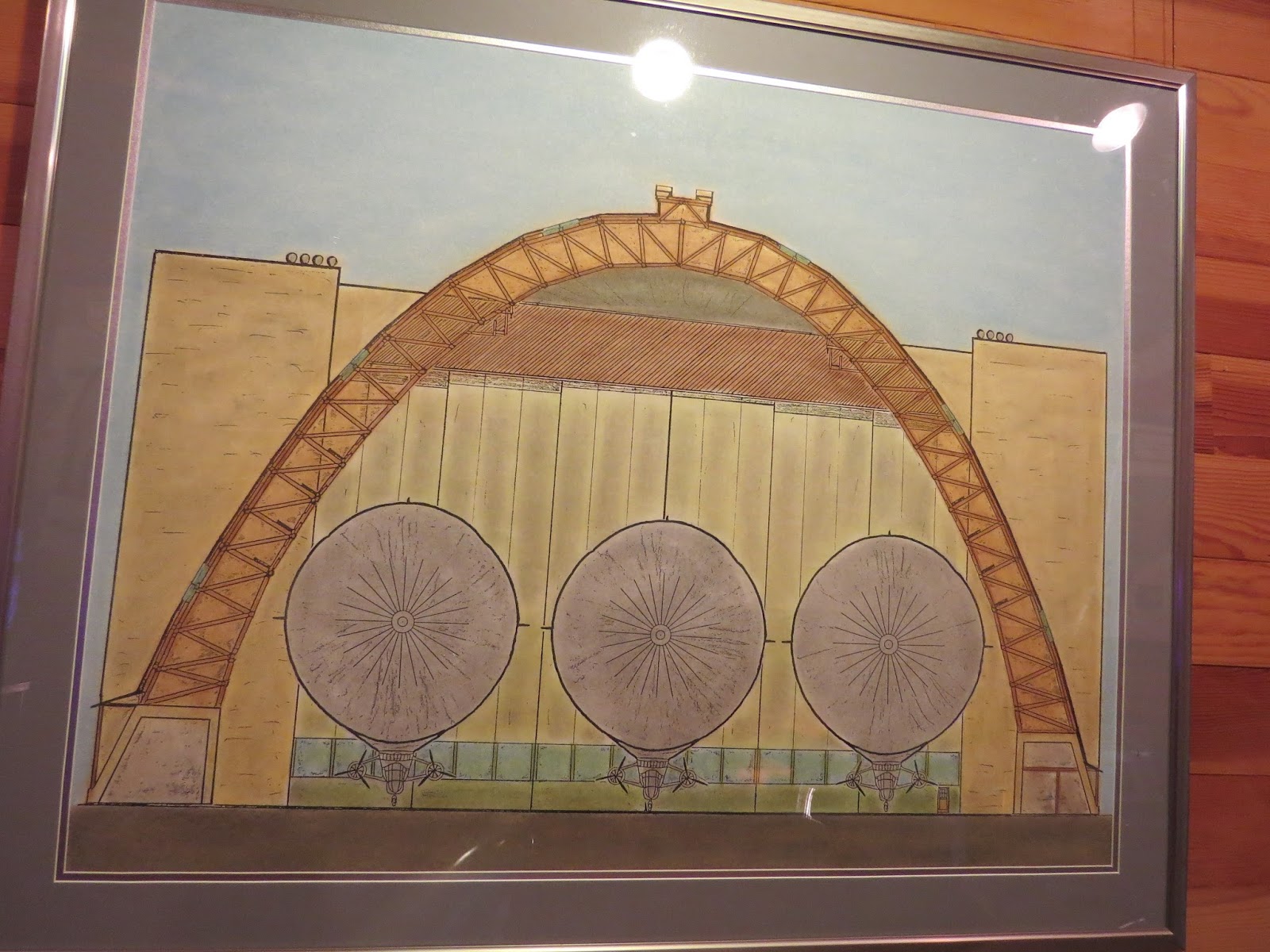
The Huge Airship Hangars
From a sign below the picture. What would fit in each hangar: Easily, 4 Boeing 747's, or over 1,200 parked automobiles could be placed on the open floor space of any one of these amazingly huge hangars. The total interior floor space of each hangar covered almost seven acres (297,000 sq. ft.). Four massive concrete door supports located at the corners of Hangar #1 were 148 ft. high and had a base of 28 ft. wide x 50 ft. long. They were one-of-a-kind, huge thick columns with a door pocket 12 ft. wide x 37 ft. deep. Only one of NAS Richmond's great door support columns remains - the east corner of "A & R" Hangar #1. It now "towers" over the Train Display Building and Museum Store of the gold Coast Railroad Museum. On the northwest face of the massive east door
receptacle (the tower now remaining) you can see a long black arc. The arc
traces the point at which Hangar #1s outer roof covering met the concrete face
of the tower. Project this arc up beyond the concrete and you may imagine how
the roof extended twenty-two feet above the 148-foot height of the concrete door
pocket. At their highest point, the hangars were the height of a seventeen-story
building, the fifty-one parabolic; wooden trusses in each of the three hangars
contained approximately 2 million board feet of Oregon Douglas Fir. The use of
wood saved over 16,000 tons (32,000,000 pounds) of war needed steel on this base
alone! Roof construction of each hangar was facilitated by the use of a
"Traveler", a huge mobile, wooden scaffold 150 feet high that spanned the inside
width of the hangar. It moved along the hangar's roof and could have built
approximately 250 three-bedroom homes. The openings at each end of the hangar #1
were 121 ft. high, and 197 ft. wide. To secure these huge portals, a set of six
separate steel sections together formed the doors for each opening. Each of the
six sections were 122 ft. high, 35 ft. wide and 4 ft. thick. Door sections
weighed 39 tons each. Under the base of the doors the concrete was poured five
feet thick. Hangar #1 was the first of these mammoth hangars to be completed.
The first airship, "K-46", occupied hangar #1 on June 9, 1943. Hangars #2 and #3
were completed and in use shortly thereafter.
East door
receptacle on the remaining tower. Museum store also shown.
Above two photos show the concrete bases for the hangar wood structure.
The trains are in the structure on the left.
Gold Coast Railroad Museum web pages about the base. Includes some first person accounts and photos from both before and after the hurricane.
A Pullman observation originally built in 1929 as a private car and converted for presidential use during WW II. It served as Presidential Rail Car No. 1 from 1943 until 1958.
The Gold Coast Railroad Museun acquired the Ferdinand Magellan in 1958 and it arrived at the museum on January 15, 1959. In 1984 the Ferdinand Magellan was briefly loaned to the presidential re-election campaign of Ronald Reagan, who gave a series of "whistlestop" speeches from the rear platform during a one-day trip in Ohio.
Above photos July 7, 2015 at Gold Coast Railroad Museum, Miami Fl.